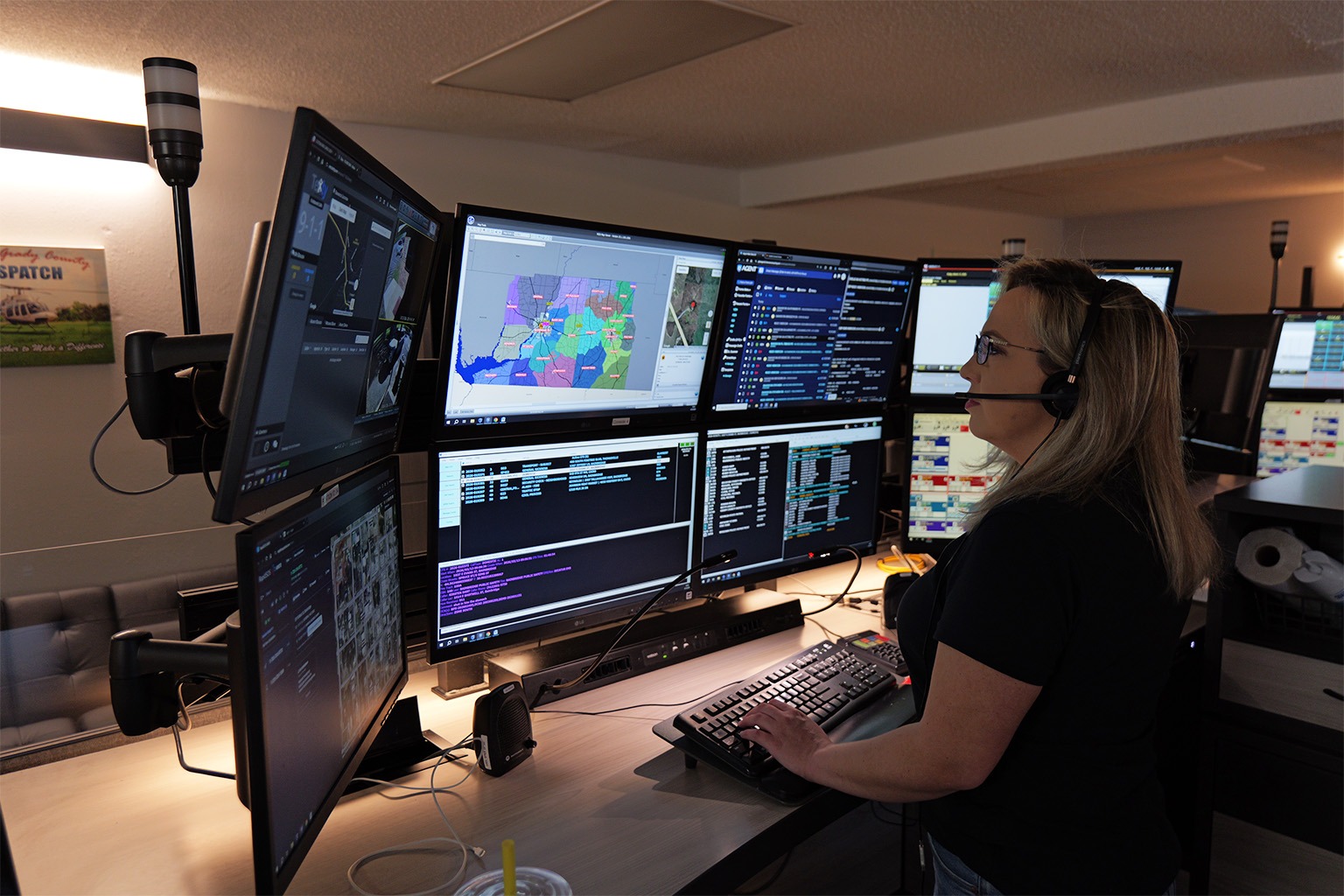
Katie Ladner: How a Decatur-Grady 911 dispatcher became the lifeline for two lost girls
Every single day, the Decatur-Grady 911 dispatch center hums with the familiar chaos of emergencies stacked on emergencies. Phones ring, radios crackle, and eight glowing screens illuminate the faces of unseen heroes who work diligently to take every call.
One of these dispatchers has spent 13 years guiding strangers through the worst moments of their lives. Her name is Katie Ladner, and she will tell you she is just doing her job. But anyone who has watched her work knows better.
She grew up around law enforcement — her mother worked with the Cairo Police Department — and Ladner absorbed the life of public safety long before she ever put on a headset. After high school, she found herself working as a secretary at the Whigham Police Department. One sergeant, Bruce Lowe, saw something in her, telling her she should spread her wings and try dispatch.
In February 2013, she took her first 911 call. She never looked back and worked her way up to the position of senior operator.
“It just clicked, “ she said. “It’s something just built in you. If you’re made to do it, you’re just made to do it.”
Dispatching is not a job for the faint of heart. Ladner describes the requirements bluntly.
“Strong‑willed, definitely has street smarts, good work ethic, and a little bit — a lot — of wit,” she said. “You have to have a tough personality. You have to be pretty tough.”
To Ladner, toughness is the ability to stay calm while talking someone through CPR, logging police chases, and tracking fire units across two counties. At any given time, she is on the phone with 20-30 people, and she has to know exactly where they are and if they’re OK.
Ladner would tell you herself she’s very good at what she does.
“I’m not confident in any other aspect of my life,” she said. “But my job? You can’t touch me.”
Decatur and Grady counties share a dispatch center, but not the luxury of extra staff. Call volume has tripled in the last five or six years, yet the number of dispatchers hasn’t changed much. She said some newcomers find it hard to put in the work required.
“It’s a very hard job,” she said. “People come in and find out just the extent of it, and it overwhelms them, and I don't blame them.”
It’s hard work, but it’s important work. Ladner wants the community to always remember that.
“Every emergency starts with 911 and people forget that,” she said. “If 911 was not there, help’s not coming.”
The job demands compartmentalization, a skill Ladner has learned the hard way.
She has cried on calls. She has thrown off her headset and stepped outside to breathe before returning to finish her shift. She has heard babies take their first breaths and their last. She has listened to ribs break during CPR. She has guided parents through the unthinkable.
Despite these events, she has to disconnect herself emotionally to make it to the next call.
There’s always a next call, and they’re never positive.
“It's always negative,” she said. “Nobody calls 911 because they're having a good day. So all day for 12 hours is negative, negative, negative. You have to learn to turn it off.”
On her days off, she often finds herself drained without realizing why.
“I have absolutely no energy, and it's because I hold on to everything. I can't let it go, and I don't even realize that it's depression and anxiety just built up,” she said. “You're on 100 the entire time you're here. Then you leave here, you go home, deal with things you have to deal with, get in bed, and come right back to it. And you don't get many days off.”
Her mother is usually the first to notice when she’s nearing a breaking point. She’ll tell Ladner to just come talk or simply sit with her momma.
“She is extremely, extremely good at knowing when I'm on the edge of losing it,” Ladner said.
Ladner is open about mental health — hers and others’. She worries more about her coworkers’ well‑being than her own. She worries about the deputies on the road. She worries about the callers she can’t save.
But she rarely worries about herself. She certainly doesn’t worry about the pay, though her center is among the highest paid in Georgia.
“I've never done it for the pay, I do it because I love what I do — and because the guys and girls on the other side of the radio, they feel safe whenever they hear my voice.”
On the day that would eventually make her a RapidSOS hero, Ladner wasn’t thinking about recognition. She was thinking about a dot.
RapidSOS is a tool that allows dispatchers to pinpoint a caller’s location with remarkable accuracy — sometimes down to the room they’re in. Ladner is known for noticing things others miss.
“They make fun of me because I’m extra,” she says. “I notice everything.”
Before the phone even rang, she saw a dot appear in the middle of the woods.
When she answered, a young girl’s voice came through. She and her younger sister had wandered into the woods and couldn’t find their way out. They didn’t know their grandmother’s address. They didn’t know where they were.
Ladner did.
“The first thing I let her know was, ‘I can see where you are.’”
She guided them step by step — “turn right,” “turn left,” “go straight” — watching the dot move across her screen. She warned them not to approach houses. She warned them not to go near the dangerous road nearby. When they got turned around, she stayed steady.
“I said, ‘Don't panic, but we've gotten turned around. I want you to completely just stop, turn around the complete opposite way and start walking, and let me see if you're going the right way.’”
She coordinated with another dispatcher, logged EMS and fire traffic, and kept her voice calm as daylight faded. The girls were the same age as her nieces.
“If they were mine, I’d be freaking out,” she said. “But I couldn’t let her know I was worried.”
A sheriff’s deputy reached them in about six minutes. He spoke gently, reassuringly — something Ladner appreciated.
Then she hung up.
And took the next call.
“I didn’t realize just how big of an impact I had,” she said.
Ladner has used RapidSOS to find a woman held against her will, a man stranded in the lake, and a heart attack victim in the woods. That’s the paradox of dispatch work: the extraordinary becomes routine, and the routine is almost never acknowledged.
Ladner is 33. She has never married and has no children. She has missed birthdays, holidays, family dinners, and funerals.
“This is my life,” she said. “It’s a 110% sacrifice.”
Her nieces are her world, but she rarely sees them. She is constantly on call. She has worked 16 or 17 days straight before. She eats at her console. She gets no lunch breaks. But she loves her job.
When asked what “hero” means, Ladner doesn’t hesitate.
“Being a hero is making a difference in someone’s life without the need of recognition,” she said. “You do it because of a passion. You might have 15 losses, but that one win makes you want to keep going.”
Post a comment